


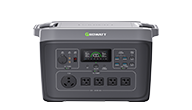
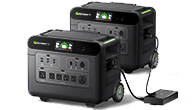
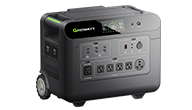


Growatt sells two 48V LiFePO4 batteries on the same collection page, at prices that differ by a factor of two per kilowatt-hour, and neither product page explains when to buy which. This is that explanation.
The short version: one HOPE cabinet replaces two ALP modules, holds 66% more usable energy, and costs $259 less. That one sentence decides most of the projects we get asked about, and the rest of this article is the handful of cases where it does not.
The numbers, side by side
|
|
HOPE 16.0LM-A1 |
ALP 5.0L-E2 |
|
Nominal energy |
16 kWh |
5.12 kWh per module |
|
Usable energy |
15.3 kWh |
4.6 kWh per module |
|
Nominal voltage |
51.2V (312 Ah) |
51.2V (100 Ah) |
|
Continuous discharge |
200A (10.2 kW) |
100A (5.1 kW) per module |
|
Where it installs |
indoors, dry, floor-standing |
indoors or outdoors, wall or floor |
|
Enclosure rating |
IP20 |
IP66 |
|
Warranty |
5 years standard, 10 optional |
10 years |
|
Expansion |
48 units → 768 kWh |
8 modules → 40 kWh |
|
Price |
$2,999 |
$1,629 per module |
|
Cost per nominal kWh |
$187 |
$318 |
|
Cost per usable kWh |
$196 |
$354 |
The last row is the one to read twice. Per usable kilowatt-hour — the energy you can actually draw, not the number on the box — the gap is 81%, not 70%.
Why the price differs, in one paragraph
Three things. The ALP is IP66, which means a sealed enclosure, gaskets, conformal-coated boards and a thermal design that works without vents. The ALP is modular, so every module carries its own enclosure, its own BMS board and its own terminations — eight modules means eight of everything, where the HOPE has one of each. And the ALP carries the compliance work of a product built for permitted installations. None of that is waste; all of it is cost you pay whether or not your project needs it.
The number almost nobody checks: minimum buy-in
Here is where the modular design stops looking like flexibility and starts looking like a bill.
A 10 kW inverter at 51.2V pulls roughly 195A. One HOPE delivers 200A on its own. One ALP module delivers 100A — so two modules is the minimum, not one. Buy a single module for a 10 kW system and the inverter will never reach its rating, because the battery becomes the bottleneck.
|
Continuous load |
HOPE needed |
ALP modules needed |
HOPE cost / usable |
ALP cost / usable |
|
5 kW (≈98A) |
1 |
1 |
$2,999 / 15.3 kWh |
$1,629 / 4.6 kWh |
|
10 kW (≈195A) |
1 |
2 |
$2,999 / 15.3 kWh |
$3,258 / 9.2 kWh |
|
20 kW (≈390A) |
2 |
4 |
$5,998 / 30.6 kWh |
$6,516 / 18.4 kWh |
Read the middle row and the "modular is more flexible" argument loses its footing: at the size most houses actually need, the modular battery costs more than the cabinet and holds 40% less. The only row where the ALP wins on price is the smallest one — 5 kW, one module, where you are buying 4.6 kWh usable and paying $1,629 for the privilege.
Above about 5 kW of inverter, the ALP's granularity stops being granular. You are not buying one module and adding later; you are buying two because the inverter needs two.
Energy per cabinet is a real advantage until it isn't
One HOPE is 15.3 kWh usable in a single 265 lb cabinet on wheels. Getting the same usable energy from ALP modules takes three or four of them, depending on how you round, plus wall space or floor space for each.
That cuts both ways, and this is the honest part. A 265 lb cabinet needs a door it fits through, a floor that carries it, and a path from the truck. Modules you can carry one at a time up a ladder, into a basement with a turn in the stairs, or onto a wall above a workbench. If the battery has to go somewhere a cabinet cannot physically reach, the ALP is not the compromise choice — it is the only choice.
Where it can actually go
IP20 means the HOPE has no protection against water. It belongs indoors, dry, on a solid floor, with clearance for wiring. A shed with a leaky roof is not a battery room, and a garage that floods in spring is not one either.
The ALP is IP66 and can go outside on a wall, which matters more than it sounds: it removes the argument about which interior wall loses 3 square feet to a battery, and it removes the "where do we put it" conversation that stalls a lot of retrofits.
One specification that catches people in both cases: the HOPE's charge window starts at 0°C. In an unheated space, a cold snap stops the pack accepting charge while it can still deliver — a confusing failure mode the first time you meet it. If your battery room can drop below freezing, plan for it.
Three projects, three answers
A cabin with no utility service. No meter, no inspection, no interconnection agreement — the HOPE is the obvious choice. One cabinet is 15.3 kWh usable for $196 per usable kWh, and it carries a 10 kW inverter at full load on 200A discharge. If the property grows, it parallels to 768 kWh.
A grid-tied house adding backup. The ALP is the answer here, and it is the one in this lineup built for a permitted installation. It is IP66 rated, covered for ten years, and stacks to 40 kWh in eight modules — with two modules minimum if you are backing up a 10 kW inverter.
A shop, barn, or well house on the same property as the house. Worth thinking about as two systems rather than one. An ALP bank on the house where the permit is, and a HOPE out at the pump house where the loads are a well pump and a compressor and the cost per usable kWh is the only number that matters.
Can you mix them?
No — not in parallel on the same bus. Different capacities in parallel share current unevenly, and the smaller bank does disproportionate work and ages out first. The HOPE and ALP also have different module architectures and different BMS communication.
You can run them as separate systems on the same property with separate inverters, which is the shop-and-house configuration above. You cannot put them on one bank and expect the BMS to keep them balanced.
FAQ
Is the HOPE the cheaper version of the ALP? No. They are different products. The HOPE is a 16 kWh cabinet at $196 per usable kWh for off-grid systems; the ALP is a 5.12 kWh modular battery at $354 per usable kWh, IP66 rated and covered for ten years. Cheaper per kilowatt-hour, not cheaper quality.
How many ALP modules do I need for a 10 kW inverter? Two. Each module delivers 100A continuous, which is 5.1 kW at 51.2V, so one module caps a 10 kW inverter at half its rating. Two modules give you 9.2 kWh usable for $3,258 — against $2,999 and 15.3 kWh for a single HOPE.
Can I use the HOPE for a grid-tied system? For a permitted interconnection, no — that job needs the ALP, which is UL 1973 and UL 9540A listed. For an off-grid system with no interconnection agreement, the HOPE is the right battery and there is nothing to give up.
Which one has a longer warranty? The ALP, at 10 years. The HOPE is 5 years standard with a 10-year option. Check which option is included in the price you are quoted.
Can I expand the HOPE later? Yes, up to 48 units in parallel for 768 kWh. This is the highest expansion ceiling in the lineup and it is why the HOPE suits properties that grow in stages.
Which is better for a boat or RV? Neither, really — both are stationary products. The HOPE is 265 lb with wheels; the ALP modules are wall or floor mounted. For mobile applications you want a different product category entirely.
Do both need the same inverter? Both communicate over CAN and RS485 with Growatt's 48V hybrid and off-grid inverters. The HOPE is documented for closed-loop operation with the SPH, SPE and SPF 3500TL series; the ALP works across the same family. Third-party 48V inverters generally run in voltage mode without closed-loop BMS data.
Compare them side by side: the Growatt HOPE 16.0LM-A1 is 16 kWh nominal, 15.3 kWh usable, 312 Ah at 51.2V, 200A discharge — one cabinet carries a 10 kW inverter at full load for $196 per usable kWh. The ALP 5.0L-E2 is 100 Ah and 5.12 kWh per module, IP66, ten-year warranty, stackable to eight modules. Both live in the home battery storage collection. To convert capacity into the amp-hours your inverter manual uses, read how many Ah is a 16 kWh battery.
Specifications are quoted from the current product specification tables and were accurate at the time of publication. UL 1973 and UL 9540A are standards of UL Standards & Engagement. Growatt® is a trademark of Growatt New Energy. This article is informational and does not constitute engineering or code-compliance advice; verify listing status and code requirements with your AHJ before purchase.

