


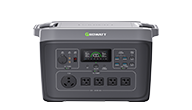
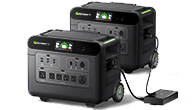
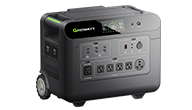


Two 6kW, 48V, split-phase off-grid inverters with dual MPPTs, UL 1741, and five-year warranties — at a price difference of roughly $100. On paper the EG4 6000XP and the Growatt SPE 6000 US look like the same product from two brands.
They are not. The difference sits in one spec that almost nobody compares: how many PV strings each unit can accept without a combiner box. That single number decides whether your array can face three directions, and it is where these two units part company.
Here is the honest comparison — including the four categories where EG4 wins.
The 30-second answer
|
If this describes you |
Buy |
|
Array has two or more orientations (e.g. east + south + west), or you want long high-voltage strings |
SPE 6000 US |
|
You need 208V or 220V three-phase for a shop or small commercial building |
SPE 6000 US |
|
A large generator has to carry the whole building's loads through the inverter |
SPE 6000 US |
|
You plan to stack beyond 54kW of capacity |
EG4 6000XP |
|
Lowest possible entry price matters more than input flexibility |
EG4 6000XP |
|
You want the largest surge rating for starting big motors |
EG4 6000XP |
Everything below explains why.
Side-by-side specifications
|
Specification |
Growatt SPE 6000 US |
EG4 6000XP |
|
Rated AC output |
6,000W, 120/240V split-phase |
6,000W, 120/240V split-phase |
|
Max output current |
25A |
25A per line |
|
Surge capacity |
120% for 10s / >120% for 5s |
12,000W for 3.5s / 11,000W for 5s |
|
THD |
<5% |
<3% |
|
Transfer time |
≤20ms single / ≤30ms parallel |
<15ms single / <30ms parallel |
|
Max PV input power |
9,000W (4,500W per MPPT) |
8,000W (4,000W per MPPT) |
|
Max DC input voltage |
550Vdc |
480Vdc |
|
MPPT operating window |
60–480Vdc |
120–385Vdc |
|
MPPT trackers / string inputs |
2 trackers, 2 strings each (4 total) |
2 trackers, 1 string each (2 total) |
|
Max input current per MPPT |
27A (34A Isc) |
17A (25A Isc) |
|
AC input |
16,800W, 70A passthrough, separate grid + generator inputs |
9,000W, 50A bypass, dedicated GEN port (up to 7kW) |
|
Battery charging |
140A |
125A (115A from AC) |
|
Battery chemistry |
Lithium / lead-acid / GEL |
Lithium / lead-acid |
|
Parallel ceiling |
9 units = 54kW |
16 units = 96kW |
|
Three-phase output |
208V / 220V |
Not supported |
|
Smart load / dump load control |
Yes |
No |
|
Idle consumption |
PV <65W, battery ~75W |
~30W with PV |
|
Protection rating |
IP20 |
IP20 |
|
Weight |
21.5kg (47 lb) |
24kg (53 lb) |
|
Warranty |
5 years |
5 years |
|
Certification |
UL 1741, FCC |
UL 1741, FCC Part 15 Class B |
|
Street price |
~$1,599 |
~$1,499–1,899 |
Where the SPE 6000 US actually wins
1. Four string inputs instead of two
This is the specification that decides real installations, and it is buried in the manual rather than the marketing.
The SPE 6000 US accepts two strings per MPPT — four independent strings total. The EG4 6000XP accepts one string per MPPT — two total.
Why it matters: a roof with panels facing east, south, and west produces three different voltages and currents at any given moment. If the inverter only has two inputs, you must either parallel mismatched strings onto one tracker (which drags the whole array down to the weakest orientation) or add an external combiner and accept the losses.
With four inputs, each orientation gets its own tracker pair. On a cabin with a south-facing roof and a separate ground mount, four inputs means no combiner box, no fusing on the roof, and no mismatch penalty.
The current headroom reinforces it: 27A per MPPT (34A Isc) versus 17A (25A Isc). That is roughly 59% more current capacity per tracker — enough to run two parallel strings of modern 450W modules on a single tracker without clipping.
2. 9,000W of PV instead of 8,000W
A 12% larger array on the same inverter. On an off-grid system where every winter kilowatt-hour has to come from the array, that extra 1,000W is an extra ~4–5 kWh per clear day in most of the US — roughly a full battery module's worth of daily production over a season.
3. A 550V ceiling with a 480V MPPT window
Numbers on the box are easy to misread here. Both inverters advertise "480V" in some form, but they mean different things:
- SPE 6000 US: 550Vdc maximum input, MPPT tracks up to 480Vdc
- EG4 6000XP: 480Vdc maximum input, MPPT tracks only up to 385Vdc
The second number is the one that governs your string design. The EG4's MPPT stops tracking at 385V, which caps practical string length well below what its 480V rating suggests. The SPE's tracker keeps working to 480V, so longer strings stay inside the operating window instead of drifting out of it on a cold morning.
Longer strings mean fewer parallel runs, thinner cable, and less loss on the DC side. We broke the math down separately in why 550V PV input matters on a 48V off-grid inverter.
4. Grid and generator get separate AC inputs
The SPE has two AC inputs built in — 16,800W total with 70A passthrough. The grid lands on one, the generator on the other, and the inverter decides which source to use. No external transfer switch, no manual breaker dance when the generator comes on.
The EG4's dedicated GEN port handles up to 7kW with a 50A AC bypass. That is fine for a 5–7kW portable generator topping up a battery bank. It is not the same as passing 70A of a large standby generator through to the loads, which is what a whole-building off-grid setup eventually needs.
5. Three-phase 208V / 220V
Nine SPE units can be combined into a 208V or 220V three-phase system. If you are wiring a workshop with three-phase motors, a small commercial building, or a well pump that wants three-phase, this is the difference between "possible" and "not possible." The EG4 6000XP is split-phase only.
Combined with the 9-unit / 54kW parallel ceiling, one hardware platform covers a cabin and a light-commercial shop — which is exactly the deployment pattern that shows up in real off-grid installs.
6. Smart load control
The SPE can divert surplus PV to a water heater or dump load instead of throttling the array. On a system sized for winter, summer production otherwise gets clipped at midday. Dumping that surplus into hot water is free storage.
This is a genuinely uncommon feature in the 48V off-grid class, and EG4 does not offer it on the 6000XP.
Where the EG4 6000XP wins
Being straight about this matters more than winning a spec table.
1. Far higher parallel ceiling
16 units to 96kW, versus 9 units to 54kW. If the project plan is "start with one, keep adding until the building is fully served," EG4 scales almost twice as far on the same model. For a growing shop or a multi-building property, that ceiling is worth more than four string inputs.
2. Lower entry price
$1,499–1,899 versus $1,599. The overlap is wide and dealer pricing moves, but EG4's floor sits about $100 below Growatt's street price. On a nine-unit build that gap becomes meaningful.
3. Faster transfer and cleaner waveform
<15ms transfer versus ≤20ms, and THD under 3% versus under 5%. In practice both are fast enough that nothing reboots, and both are clean enough for electronics. But if you are powering sensitive lab equipment or a server rack, 3% is the better number and EG4 owns it.
4. Lower idle draw
About 30W with PV connected, versus <65W on the SPE. Over a year that is roughly 300 kWh — not nothing when the system is off-grid and every watt comes from the array.
5. A deeper DIY community
EG4 has an unusually large installed base of forum threads, YouTube walkthroughs, and wiring diagrams. For a self-installer, that support surface has real value that no spec sheet captures.
What neither inverter does
Both units are IP20 — they must be installed in a dry, conditioned space. A utility room, garage, or insulated shed works. Mounting either one on an exterior wall in the open requires a weatherproof enclosure with ventilation.
And neither one sells power back to the grid. If net metering or grid export is part of the plan, you need a hybrid inverter instead — the hybrid solar inverter lineup handles grid-tie and backup in one unit with UL 1741 SA/SB listing, and is IP65 rated for outdoor mounting.
Which one should you buy
Choose the SPE 6000 US if:
- your array faces more than two directions, or you want to add a ground mount later without a combiner
- you have a standby generator larger than 7kW that should carry building loads, not just charge batteries
- you need three-phase for a shop, or you expect to expand into one
- you want smart load diversion for water heating
Choose the EG4 6000XP if:
- you are building incrementally and expect to pass 54kW eventually
- the lowest possible per-unit price drives the budget
- you are a first-time DIY installer who values a large body of community documentation
- your loads are simple: one array orientation, one generator, single-phase only
Choose neither if you need grid export, outdoor mounting, or a 10-year warranty — those are hybrid-inverter features. The off-grid inverter collection lists what each model actually covers.
FAQ
Can I parallel an EG4 6000XP with a Growatt SPE 6000 US? No. Parallel operation requires identical models on shared communication and phase synchronization. Units from different manufacturers cannot be paralleled, and mixing them on one battery bank will cause circulating currents and control conflicts.
Which one starts a well pump or air compressor better? The EG4 has the higher published surge — 12,000W for 3.5 seconds versus the SPE's 120% overload for 10 seconds (7,200W). For a hard-starting motor, the EG4's short burst is more forgiving. The SPE compensates with a longer overload window, which suits sustained overloads better than instantaneous inrush. Either way, a soft-starter on the pump removes most of the problem.
Do both support closed-loop lithium communication? Yes, but within their own ecosystems. The SPE uses CAN/RS485 to talk to Growatt ALP and HOPE batteries for true state of charge. The EG4 communicates with EG4 48V batteries. Both can run open-loop on lead-acid or a third-party bank, with less precise SOC tracking.
Is 550Vdc safe to work with? It is safe when installed to code and dangerous when it is not. Anything above 60Vdc is outside the "low voltage" category for practical purposes: DC arcs do not self-extinguish the way AC arcs do, and 550Vdc arrays require proper DC disconnects, arc-fault protection, and rapid-shutdown compliance under NEC 690. This is not a homeowner DIY voltage — it is an electrician's voltage. That is precisely why the higher ceiling is valuable: it lets a professional run fewer, longer strings with less cable and fewer failure points.
Ready to size the system? The SPE 6000 US product page lists full specifications, bundle pricing from $1,599, and parallel configurations up to 54kW. For a side-by-side view of every off-grid model we carry, start with the off-grid solar inverter collection.
EG4™ and 6000XP are trademarks of EG4 Electronics. Growatt® is a trademark of Growatt New Energy. All other trademarks are the property of their respective owners. Specifications for third-party products are quoted from the manufacturer's published documentation (EG4 6000XP spec sheet v1.4.4, April 2024, and user manual) and were accurate at the time of publication. Manufacturers change specifications without notice — verify current figures with the manufacturer before purchase. This comparison is published for informational purposes and does not imply affiliation with, endorsement by, or sponsorship from any other manufacturer.

